- Market Minute
- Posts
- A Quiet Climb: Strength Without Uniform Participation
A Quiet Climb: Strength Without Uniform Participation

George Tsilis
January 16, 2026

Investors were handed an unusually dense mix of macro data, earnings signals, and sector-level rotation this week, yet equity markets continued to project calm at the surface. The S&P 500 (SPX) spent the week hovering just below the psychologically important 7,000 level, holding within reach of record highs, while the Dow Jones Industrial Average ($DJI) pushed further into uncharted territory as investors favored value, dividends, and balance-sheet durability. The Nasdaq-100 (NDX) lagged for much of the week before staging a sharp late-week rebound, highlighting how leadership continues to rotate rather than broaden decisively.
Inflation data anchored the macro narrative. The December CPI report showed prices rising 0.3% month over month, with core CPI up 0.2%. On a year-over-year basis, headline CPI stood at 2.7%, while core CPI held at 2.6%. The report confirmed that disinflation remains intact but gradual. Shelter and food components stayed firm enough to keep policymakers cautious, leaving markets comfortable with the Federal Reserve’s patient stance rather than pricing in an aggressive follow-up easing cycle. Treasury yields remained relatively stable, helping equities maintain elevated valuations without triggering a sharp repricing in rate expectations.
Sector performance reflected this balance. Consumer staples were among the strongest performers in the S&P 500, extending their early-year leadership as investors leaned into dependable earnings, pricing power, and lower economic sensitivity. Aerospace and defense stocks also attracted steady inflows, supported by ongoing geopolitical uncertainty and renewed political focus on military spending priorities. Industrials and utilities held up well, while technology lagged on a weekly basis despite a strong finish, underscoring how selective growth exposure has become.
Earnings season further clarified investor preferences within financials. Asset-light banks outperformed decisively. Morgan Stanley (MS) and Goldman Sachs (GS) rallied as results highlighted strength in trading, underwriting, advisory activity, and asset management flows. Investors rewarded these fee-driven models that benefit from market activity without relying heavily on balance-sheet expansion. In contrast, loan- and deposit-centric banks struggled to keep pace. JPMorgan Chase (JPM), Bank of America (BAC), and Wells Fargo (WFC) lagged as concerns persisted around net interest margin pressure, deposit competition, and slower credit growth. The divergence within financials reinforced a broader late-cycle preference for capital-light exposure over balance-sheet intensity.
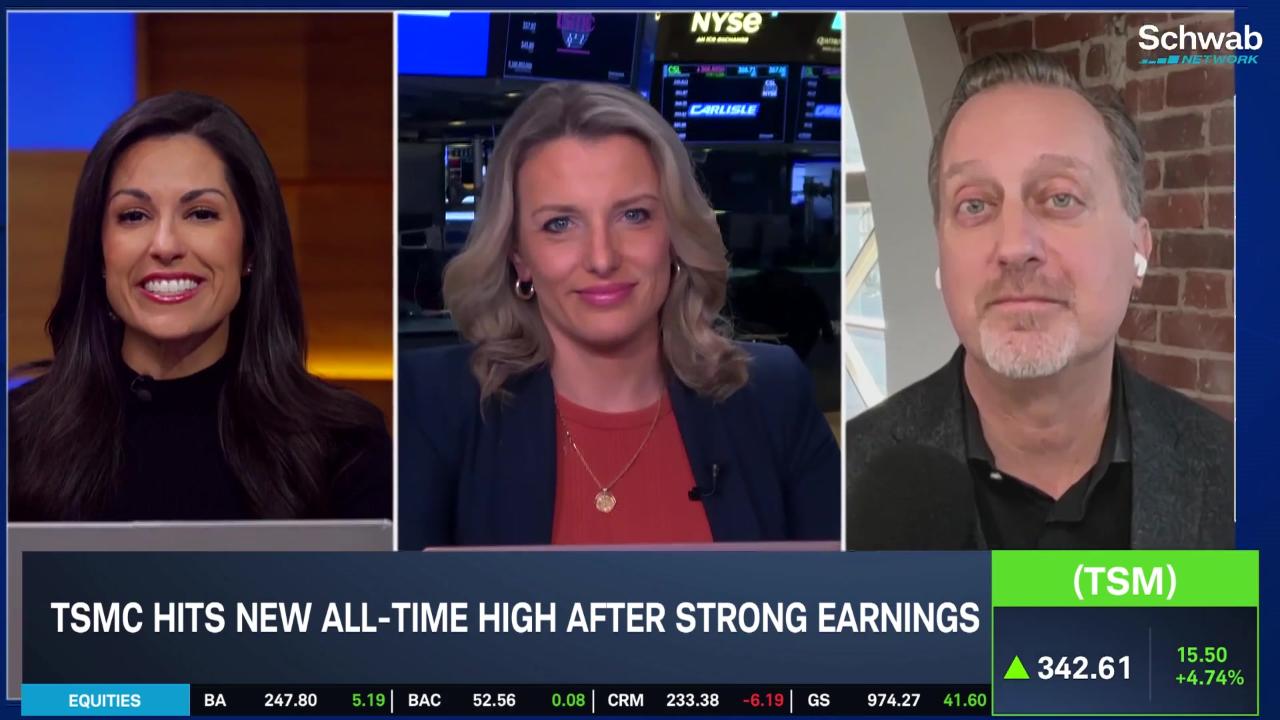
Technology leadership remained fragmented. Semiconductors powered the Nasdaq’s late-week surge, led by renewed confidence in foundry and equipment spending. Shares of TSMC (TSM) advanced as investors refocused on its central role in advanced-node production for AI and high-performance computing. That strength rippled through equipment makers Applied Materials (AMAT) and Lam Research (LRCX), while memory and storage names Micron Technology (MU), Seagate Technology (STX), and Western Digital (WDC) continued to trend constructively on signs that the cycle has stabilized.
In contrast, software remained a notable pocket of weakness within technology. High-quality application names such as ServiceNow (NOW), Intuit (INTU), and Adobe (ADBE) continued to underperform as investors questioned valuation support in a slower growth environment and rotated away from longer-duration cash flows. This divergence between hardware-linked cyclicality and software defensiveness further underscored how selective the growth bid has become.
Outside of equities, commodities added another layer to the market’s message. Gold (/GC) and silver (/SI) continued to show underlying strength, benefiting from steady real rates, geopolitical uncertainty, and ongoing demand for portfolio hedges. The resilience in precious metals contrasted with the more mixed tone in energy. WTI crude oil (/CL) held moderately above $60 per barrel during the week, reflecting a balance between supply discipline and uneven global demand. While not strong enough to ignite a broad energy rally, oil’s stability helped cap downside risk for the sector and reinforced the broader theme of consolidation rather than acceleration.
Policy uncertainty lingered in the background as markets monitored a pending Supreme Court decision on tariffs. A ruling that constrains tariff authority could ease cost pressures and support manufacturers and exporters, while an outcome that preserves broad tariff powers would keep uncertainty elevated and favor domestically oriented, defensive business models. For now, investors appear content to wait, with the issue acting as a latent catalyst rather than an immediate driver.
Looking ahead, the next phase of earnings will be critical in determining whether leadership can broaden beyond a rotating cast of winners. Reports due in the coming week include Procter & Gamble (PG), Johnson & Johnson (JNJ), Netflix (NFLX), Texas Instruments (TXN), United Airlines (UAL), and American Express (AXP). Alongside earnings, investors will watch upcoming retail sales, producer price inflation, and industrial production data for confirmation that growth is slowing but not stalling. With inflation easing, volatility contained, and indexes near record levels, the market’s next meaningful move will likely hinge less on macro relief and more on whether earnings can validate a broader, more durable advance beyond the 7,000 threshold.
Morning Minute
Featured Clip

Tune in live from 8 a.m. to 5 p.m. ET, or anytime, anywhere, on‑demand.
Or stream it via thinkorswim® and thinkorswim Mobile, available through our broker-dealer affiliate, Charles Schwab & Co., Inc
Please do not reply to this email. Replies are not delivered to Schwab Network. For inquiries or comments, please email [email protected].
See how your information is protected with our privacy statement.
This material is intended for informational purposes only and should not be considered a personalized recommendation or investment advice. Investors should review investment strategies for their own particular situations before making any decisions.
Schwab Network is brought to you by Charles Schwab Media Productions Company (“CSMPC”). CSMPC is a subsidiary of The Charles Schwab Corporation and is not a financial advisor, registered investment advisor, broker-dealer, or futures commission merchant.
Charles Schwab Media Productions Company and all third parties mentioned are separate and unaffiliated, and are not responsible for one another's policies, services or opinions.
Data contained herein is obtained from what are considered reliable sources. However, its accuracy, completeness, or reliability cannot be guaranteed. All events and times listed are subject to change without notice.