- Market Minute
- Posts
- Markets Search for Support as Traders Brace for Another Uncertain Weekend
Markets Search for Support as Traders Brace for Another Uncertain Weekend

George Tsilis
March 27, 2026

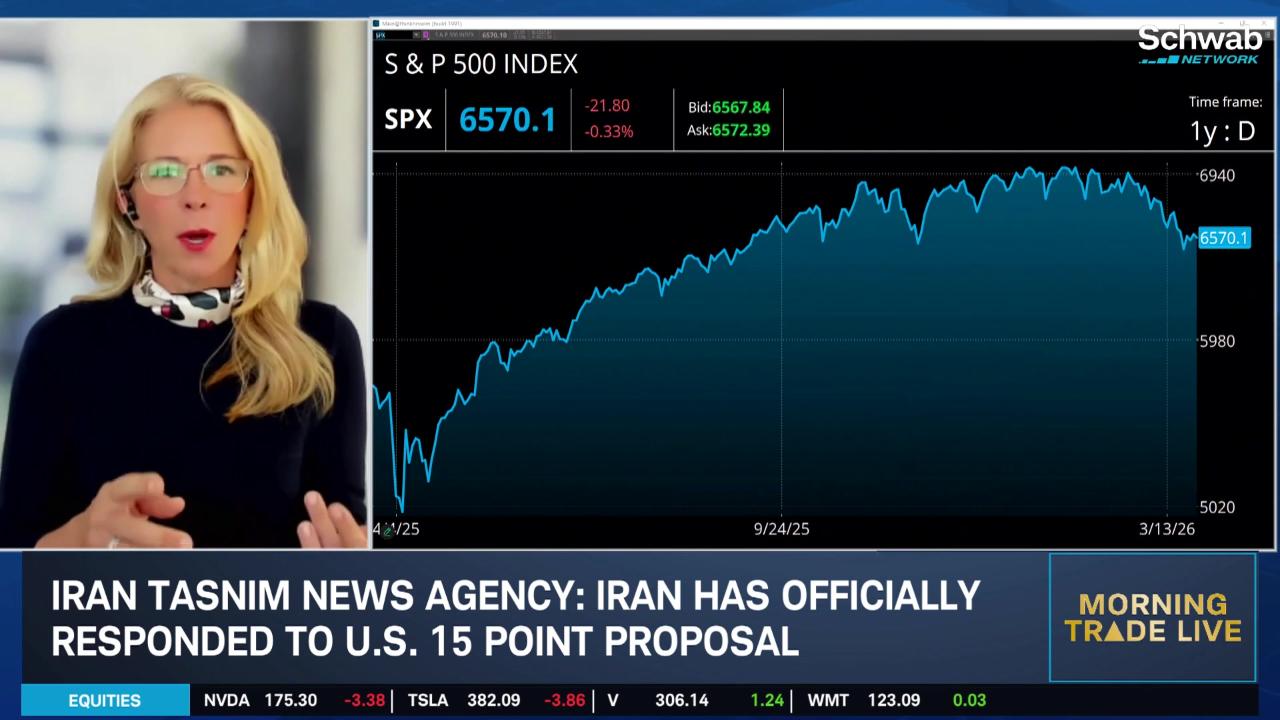
Financial markets remain locked in a rolling correction, defined by a volatile reassessment of the “higher-for-longer” interest rate environment, as investors continue to navigate shifting geopolitical headlines, elevated bond yields, and mixed economic data. The result has been a grueling stretch of price discovery across asset classes, with the S&P 500 (SPX) falling 0.5% for the week and once again testing prior lows.
More notably, the benchmark index is now pressing against its 50-week moving average, a key long-term technical level that many traders view as an important line of support in broader uptrends. Unless equities can catch a strong bid in today’s trading session, the market may be headed for a fifth straight weekly decline. Even then, some investors may be reluctant to carry significant risk into another weekend clouded by geopolitical uncertainty.
At the center of market unease remains the evolving situation in the Middle East. While tensions involving Iran continue to disrupt sentiment and inject volatility into global markets, a temporary pause announced by President Donald Trump—extending through April 6—has provided only limited relief. The market response suggests that traders remain skeptical that the current reprieve will produce a durable de-escalation. Instead, investors appear to be pricing in the possibility that hostilities could re-intensify at any time, particularly over a weekend when headlines can emerge outside of market hours and force sharp repricing by Monday’s open.
Energy markets have reflected that instability. WTI crude oil (/CL) is down about 1% on the week to roughly $97 per barrel, but that modest net decline does not come close to capturing the extraordinary volatility beneath the surface. During the week, prices surged above $100 before plunging toward $85, underscoring just how fragile global supply expectations have become. Oil’s violent swings are feeding uncertainty across equities, inflation expectations, and monetary policy assumptions.
That same tension has been evident in volatility markets. The CBOE Volatility Index, or VIX, climbed to near the 30 level, signaling elevated demand for downside protection and an expectation of continued large daily price swings. Investors are no longer pricing in a calm macro environment. Instead, markets increasingly reflect a world shaped by geopolitical shocks, sticky inflation, and policy rates that may need to stay restrictive longer than many had hoped just a few months ago.
Fixed income markets have offered little refuge. Treasury yields continued to move higher following the Federal Reserve’s recent hawkish tone. The 10-year Treasury yield rose to 4.46%, its highest level since mid-2025, while the 2-year yield approached the 4% mark. The move has reinforced a bear-flattening of the yield curve, a classic signal that investors are bracing for slower growth even as inflation pressures remain persistent. Rising yields continue to weigh heavily on equities, especially growth and other rate-sensitive sectors, while also tightening financial conditions more broadly.
Sector performance this week highlighted a sharp divergence driven by rates and commodity dynamics. Energy led the market, gaining more than 4% as elevated oil prices supported earnings expectations despite the underlying volatility in crude. Materials also outperformed, rising more than 3% on the back of commodity strength and inflation-linked pricing power.
On the other side of the ledger, technology stocks fell more than 4% this week, pressured by higher yields that continue to compress valuations for long-duration growth assets. Communication services declined 5% while Information Technology is down 1.5% as tech continues to struggle. The widening gap between winners and losers shows just how sensitive sector leadership has become to every move in yields, energy, and inflation expectations.
Economic data added another layer of complexity. The S&P Global Composite PMI for March slipped to 51.4 from 51.9, its lowest reading in nearly a year. While still technically in expansion territory, the decline points to cooling economic momentum. Meanwhile, initial jobless claims rose modestly to 210,000, suggesting the labor market remains relatively resilient, though perhaps no longer as strong at the margin as it had been earlier in the cycle.
Currency and metals markets reinforced the broader macro theme this week. The U.S. dollar ($DXY) strengthened roughly 0.70%, supported by higher yields and safe-haven demand. At the same time, gold (/GC) and silver (/SI) remain under pressure, a sign that rising real yields and dollar strength are overpowering traditional geopolitical safe-haven flows.
Taken together, the week’s price action points to a market wrestling with a difficult mix of slowing growth, persistent inflation pressure, rising yields, and headline-driven geopolitical risk. With the S&P 500 testing its 50-week moving average and potentially staring down a fifth consecutive weekly loss, today’s session could carry outsized technical and psychological importance. Whether buyers step in aggressively or traders choose to reduce exposure ahead of another uncertain weekend may help define the tone heading into next week.
Morning Minute
Featured Clip

Tune in live from 8 a.m. to 5 p.m. ET, or anytime, anywhere, on‑demand.
Or stream it via thinkorswim® and thinkorswim Mobile, available through our broker-dealer affiliate, Charles Schwab & Co., Inc
Please do not reply to this email. Replies are not delivered to Schwab Network. For inquiries or comments, please email [email protected].
See how your information is protected with our privacy statement.
This material is intended for informational purposes only and should not be considered a personalized recommendation or investment advice. Investors should review investment strategies for their own particular situations before making any decisions.
Schwab Network is brought to you by Charles Schwab Media Productions Company (“CSMPC”). CSMPC is a subsidiary of The Charles Schwab Corporation and is not a financial advisor, registered investment advisor, broker-dealer, or futures commission merchant.
Charles Schwab Media Productions Company and all third parties mentioned are separate and unaffiliated, and are not responsible for one another's policies, services or opinions.
Data contained herein is obtained from what are considered reliable sources. However, its accuracy, completeness, or reliability cannot be guaranteed. All events and times listed are subject to change without notice.