- Market Minute
- Posts
- The Broad Market is Searching for Direction
The Broad Market is Searching for Direction

George Tsilis
February 20, 2026

The week unfolded as another volatile stretch for U.S. markets, with equities struggling to regain upside momentum as economic data, policy developments, and earnings dispersion kept conviction restrained. The S&P 500 traded roughly flat after several sharp intraday swings, while the Dow Jones Industrial Average drifted lower. The broader tape remains locked in an uncertain trading range, unable to reclaim prior highs and increasingly defined by defensive rotation beneath the surface.
Economic data this week offered a clearer read on slowing momentum. Industrial Production (year-over-year) for January decelerated, reflecting softer manufacturing output and continued inventory normalization across several cyclical industries. While not signaling outright contraction, the slowdown reinforced concerns that higher rates and cautious capital spending are beginning to weigh more meaningfully on production. The manufacturing component remained uneven, with pockets of resilience offset by weakness in durable goods and export-sensitive segments.
Labor market indicators also showed incremental softening. The four-week average of initial jobless claims moved higher, signaling a gradual cooling in hiring conditions. While weekly claims remain historically moderate, the upward drift in the four-week average is often viewed as a more reliable trend gauge, suggesting layoffs are beginning to edge higher as firms adjust to slower demand.
Wednesday’s release of the FOMC Meeting Minutes added important context to rate expectations. The minutes revealed that policymakers remain cautious about declaring victory over inflation, with several members emphasizing that services prices and wage growth still warrant vigilance. At the same time, the Committee acknowledged that financial conditions have tightened at the margin and that economic activity is moderating.
Rates markets reflected that nuanced stance. The 10-year Treasury yield, which had fallen close to the 4.0% level earlier in the week amid growth concerns, firmed modestly after geopolitical developments involving Iran triggered a brief inflation scare tied to rising energy prices. Comments from President Trump heightened concerns that escalating tensions could lift oil prices and reintroduce energy-driven inflation pressures. The combination of softer industrial data and geopolitical risk left yields oscillating but broadly supported.
A potential major policy development which could also shape sentiment is the Supreme Court decision on the legality of tariffs, which could come as soon as today. A lower court initially ruled that key portions of certain tariff measures were unlawful, creating short-term volatility. After that ruling, Treasury yields spiked on speculation that the government might need to refund collected tariff revenues, potentially increasing near-term issuance needs. Equities briefly sold off on that fiscal uncertainty.
However, the longer-term implications appear constructive. Removing tariffs reduces cost pressures for businesses, lowers consumer prices, and eliminates a modest fiscal drag on GDP growth. Over time, the ruling could prove disinflationary and supportive for corporate margins, potentially laying the groundwork for the next sustained leg higher once transitional volatility subsides.
Sector performance this week reflected continued defensive positioning. Consumer staples once again outpaced consumer discretionary, reinforcing the message that institutions are rotating toward earnings stability. The staples-over-discretionary ratio remains elevated, often interpreted as a warning that growth leadership is narrowing. Value stocks continued to outperform growth, while utilities and healthcare showed relative resilience. Technology, particularly software, lagged once again.
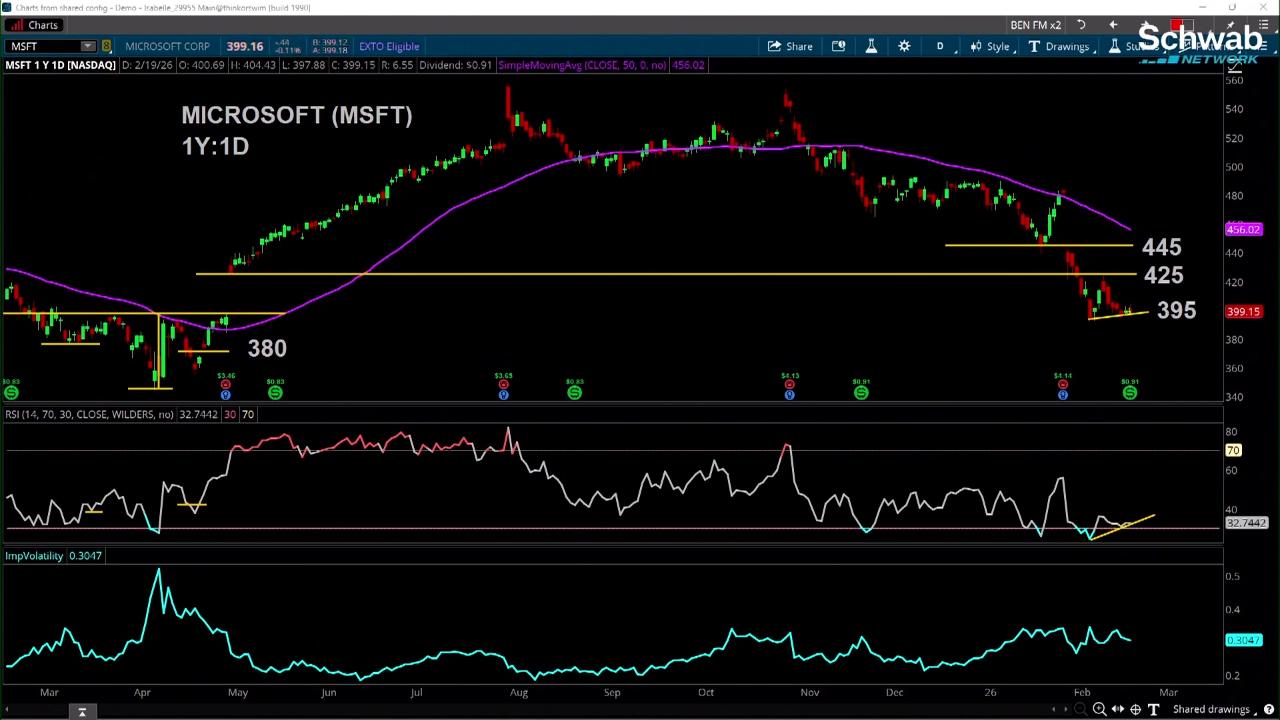
Concerns that generative AI tools could erode competitive moats around enterprise software platforms continued to weigh on valuations. Large-cap software names struggled, and the broader Nasdaq Composite is now approaching its 200-day moving average, while the Roundhill Magnificent Seven ETF (MAGS), which tracks mega-cap growth leaders, briefly tested its own 200-day level earlier in the week. These technical levels are increasingly important as markets search for support within a distribution pattern.
Earnings added to the mixed tone. Walmart (WMT) reported solid revenue growth but cautious guidance, reflecting a consumer that remains active yet price sensitive. Analog Devices (ADI) highlighted industrial softness and inventory normalization. Ebay (EBAY) showed stabilization but limited margin expansion. Palo Alto Networks (PANW) faced selling pressure after billing growth decelerated, reinforcing concerns about enterprise IT spending discipline. Across reports, markets rewarded clarity and punished uncertainty.
Cross-asset signals remained defensive. The U.S. dollar strengthened, reflecting safe-haven demand, while long-duration Treasurys saw two-way volatility but remained supported by softer industrial data. Commodities were mixed, with energy bid on geopolitical headlines and industrial metals lacking follow-through. The CBOE Volatility Index (VIX) above 20 also suggest a cautious tone.
Morning Minute
Featured Clip

Tune in live from 8 a.m. to 5 p.m. ET, or anytime, anywhere, on‑demand.
Or stream it via thinkorswim® and thinkorswim Mobile, available through our broker-dealer affiliate, Charles Schwab & Co., Inc
Please do not reply to this email. Replies are not delivered to Schwab Network. For inquiries or comments, please email [email protected].
See how your information is protected with our privacy statement.
This material is intended for informational purposes only and should not be considered a personalized recommendation or investment advice. Investors should review investment strategies for their own particular situations before making any decisions.
Schwab Network is brought to you by Charles Schwab Media Productions Company (“CSMPC”). CSMPC is a subsidiary of The Charles Schwab Corporation and is not a financial advisor, registered investment advisor, broker-dealer, or futures commission merchant.
Charles Schwab Media Productions Company and all third parties mentioned are separate and unaffiliated, and are not responsible for one another's policies, services or opinions.
Data contained herein is obtained from what are considered reliable sources. However, its accuracy, completeness, or reliability cannot be guaranteed. All events and times listed are subject to change without notice.
1